
The Architecture of Ambition: Breaking Through the Principal-to-Chief Barrier
The Problem Nobody Talks About
You’ve made it to Principal Architect. You’ve survived the technical gauntlet, shipped systems that scale, navigated organizational politics, and earned your stripes through countless late nights debugging production incidents. You’re at the top of your technical game.
And yet, the Chief Architect role remains frustratingly out of reach.
This isn’t about technical competence. You’ve already proven that. This is about understanding a completely different game with rules that were never explicitly taught. This repository exists to decode those rules and provide a strategic roadmap for architects who refuse to let their careers stall at the Principal level.
Why Most Principal Architects Never Become Chiefs
The transition from Principal to Chief Architect represents a fundamental shift in identity and responsibility. You’re no longer the person who solves technical problems. You’re the person who decides which problems matter. You’re no longer the domain expert who dives deep into specific architectural challenges. You’re the enterprise strategist who owns horizontal problems spanning the entire organization.
Most Principal Architects fail this transition because they:
- Continue operating in domain-specific silos instead of addressing enterprise-wide challenges
- Focus on technical elegance rather than business outcomes and financial impact
- Avoid the political complexity of acting as the Chief’s proxy in strategic meetings
- Design governance frameworks that optimize for control instead of enabling velocity
- Wait for recognition instead of volunteering to own transformative initiatives
- Communicate in technical jargon rather than translating architecture to executive language
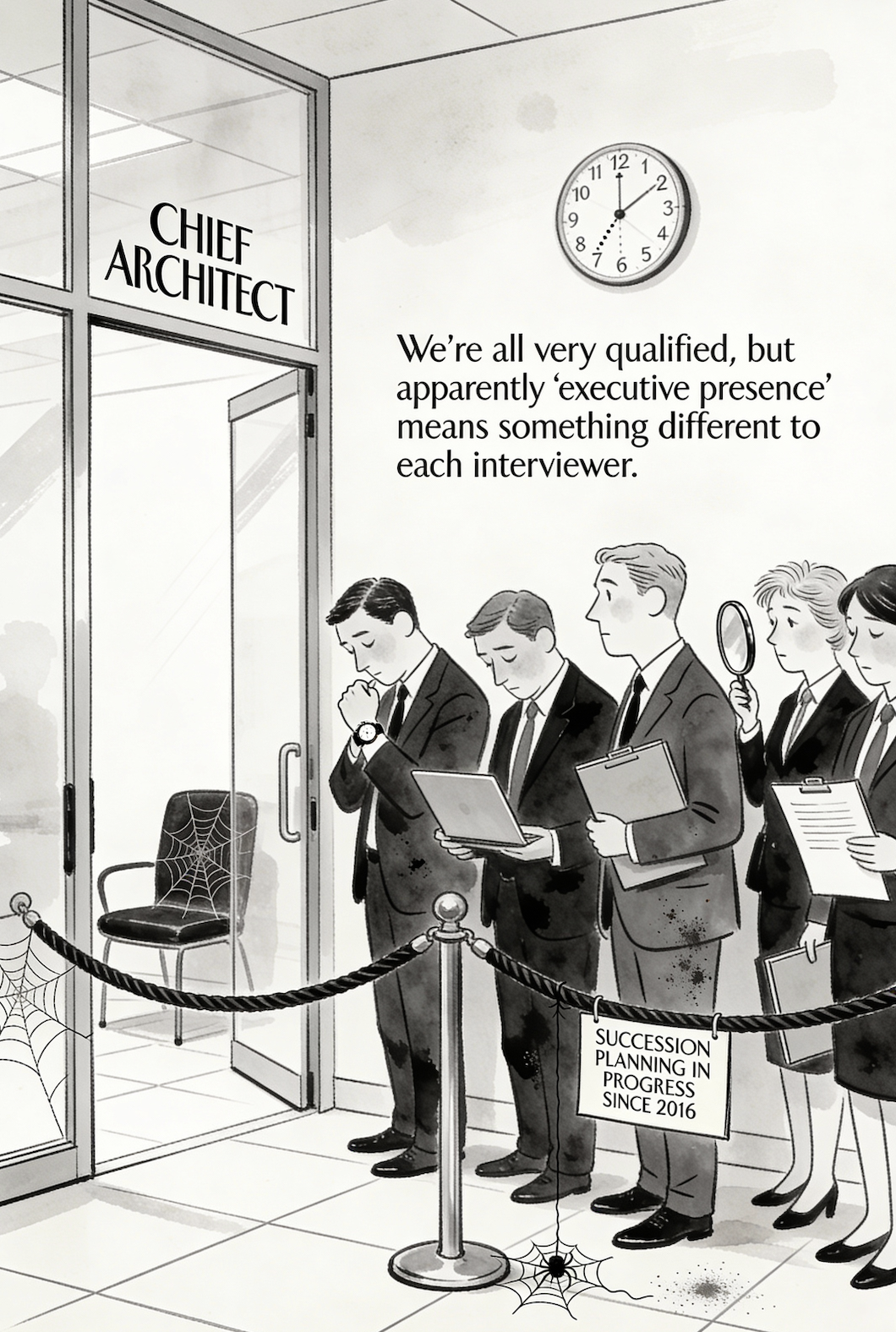
- Stay in organizations with entrenched leadership and no succession planning
The gap isn’t about skill. It’s about strategic positioning, executive presence, and knowing when your current environment will never promote you.
The Strategic Framework
The career progression from Principal to Chief Architect demands mastery across five interconnected strategic areas:
Own Horizontal Problems
Stop being the expert in payments architecture or identity management. Start being the person who owns technical debt across the entire enterprise. Integration strategy that determines whether cloud migration succeeds or fails. Cloud cost optimization that saves millions annually. AI governance frameworks that prevent regulatory disasters and reputational damage.
These problems have no natural owner. They fall between organizational silos. So they don’t get solved. They compound. Then they become existential threats.
Organizations tackling architectural debt through systematic remediation achieve reductions of thirty to fifty percent in operational overhead. That’s real money. That’s executive language. That’s how you demonstrate you think beyond your domain.
Act as the Chief’s Proxy
When the Chief Architect asks you to run the architecture council, you’re being auditioned. This isn’t a favor. It’s a test of whether you can represent the architectural vision without needing the title. Whether you can navigate stakeholder politics. Whether you can pre-brief executives to build alignment before formal meetings. Whether you can say no to powerful people while making them feel heard.
Running architecture councils at companies like Netflix and Spotify isn’t about gatekeeping decisions. It’s about enabling consistent, scalable decision-making across organizations too large for command-and-control. These councils reduce project delivery times and costs through standardized processes while maintaining architectural coherence.
If you can’t run the room when the Chief isn’t there, you won’t get the job when they leave.
Design Governance, Don’t Just Enforce It
Every enterprise architect has experienced governance that killed velocity in the name of quality. Architecture review boards where good ideas went to die waiting for approvals. Standards documentation that nobody read and fewer followed.
The future Chief Architect designs governance that people want to follow. Decision frameworks like Request for Comments processes used at Airbnb and Uber enable transparent, scalable decision-making. Delegated authority models like Amazon’s two-pizza teams and Spotify’s squads provide autonomy without chaos. Exception pathways that allow controlled deviations from standards without fragmenting the architecture.
Balance control and agility. Create systems that let teams move fast without breaking everything. Design governance as the path of least resistance rather than an obstacle course.
Own Enterprise Initiatives the Chief Can’t Execute
The Chief Architect role exists because certain initiatives are too large, too political, or too transformative for anyone else to drive. If you want that role, prove you can own those initiatives first.
Cloud migrations that require aligning business goals across divisions with competing priorities. Platform consolidation that steps on the toes of product owners who’ve built their kingdoms. AI implementation that connects data scientists to business problems worth solving. Vendor rationalization that saves real money through strategic consolidation.
These initiatives force you to lead without formal authority. Coordinate across domains. Balance competing interests. Deliver outcomes that make the CIO look good. That’s the actual job. Demonstrate you can do it before asking for the title.
Build Executive Trust Transparently
Technical architects often struggle with executive communication because they optimize for technical accuracy instead of business clarity. They hide behind jargon. They resist translating architecture decisions into financial impact. They view business stakeholders as obstacles rather than partners.
Building executive trust requires speaking their language. Create dashboards showing Total Cost of Ownership, Return on Investment, and risk quantification. Present architectural decisions in terms of business outcomes. Tailor your message to your audience. The CTO needs different context than the CEO. The Board needs different framing than product leadership.
Leaders who foster open communication and provide regular feedback create environments where trust flourishes. But open communication doesn’t mean dumping technical details on non-technical audiences. It means sharing what matters in words they understand.
Become a trusted advisor by asking insightful questions rather than always having answers. Adapt your guidance to specific contexts. Listen actively to organizational culture and understand what’s politically feasible, not just technically optimal.
When to Leave
Some organizations will never promote you to Chief Architect. Recognize the signs:
- No visible succession plan despite years of preparation
- Entrenched Chief who views succession as threat rather than strategy
- Lack of executive sponsor willing to champion your promotion
- Organizational culture that promotes from outside rather than developing internal talent
- Misalignment between your values and organizational reality
Staying in an organization that won’t promote you isn’t loyalty. It’s career stagnation. Growth blocked is growth denied. Your career needs momentum. Momentum requires motion.
Know when to architect your next opportunity elsewhere.
How My Publications Can Accelerate Your Career
The strategic framework outlined above isn’t theoretical. It’s based on decades of practical experience navigating enterprise architecture careers, combined with extensive research into what actually works versus what sounds good in conference presentations.
My publications at mohammed-brueckner.com/publications provide the detailed playbooks, frameworks, and tactical guidance that turn this strategic understanding into actionable career progression.
For Principal Architects Targeting Chief Roles
If you’re currently a Principal Architect and the Chief role feels frustratingly out of reach, these books decode the invisible rules of enterprise architecture leadership. You’ll learn how to position yourself for promotion through strategic initiative ownership, how to build executive presence that translates technical decisions into business language, and how to navigate organizational politics without compromising your technical integrity.
The books provide specific frameworks for identifying and owning horizontal problems that matter to executives. You’ll learn how to create modernization scorecards that quantify technical debt in financial terms. How to design governance frameworks that enable velocity rather than kill it. How to run architecture councils that drive consistent decision-making across large enterprises. How to pre-brief executives in ways that build trust and alignment.
For Senior and Staff Architects Planning Ahead
If you’re earlier in your career trajectory, these publications help you avoid common pitfalls that derail promising architects. You’ll learn which skills to develop now, which initiatives to volunteer for, and which organizational signals indicate you’re in an environment that supports career growth versus one that will stall your progression.
The books explain how to build a track record of enterprise-wide impact rather than domain-specific expertise. How to develop executive communication skills before you need them. How to identify mentors and sponsors who can champion your advancement. How to recognize when your current organization lacks the succession planning and leadership development necessary for your growth.
For Architects in Leadership Transitions
If you’ve recently been promoted to Chief Architect or similar enterprise leadership roles, these publications provide frameworks for your first ninety days and beyond. You’ll learn how to establish governance without creating bottlenecks, how to delegate authority while maintaining architectural coherence, and how to balance strategic vision with tactical execution.
The books cover how to build architecture councils that drive value rather than create bureaucracy. How to own transformative initiatives like cloud migration, platform consolidation, and AI implementation. How to communicate with boards and C-suite executives about architectural strategy and technical investment. How to mentor the next generation of architects while maintaining your own strategic focus.
For Organizations Building Architecture Practices
If you’re responsible for developing architecture talent in your organization, these publications provide blueprints for succession planning, leadership development programs, and career progression frameworks. You’ll learn how to identify high-potential architects, create clear pathways from Principal to Chief, and build cultures that retain top talent rather than losing them to competitors.
The books explain how to design governance structures that scale with organizational growth. How to balance architectural consistency with team autonomy. How to measure architecture value in business terms rather than technical metrics. How to create environments where architects can develop executive presence and strategic thinking alongside technical expertise.
The Practical Difference
These aren’t academic textbooks filled with theory divorced from reality. They’re based on real implementations, actual organizational challenges, and the hard lessons learned from both successes and failures in enterprise architecture leadership.
You’ll find specific templates, detailed frameworks, actual case studies, and tactical playbooks you can adapt to your context. The guidance addresses the messy reality of organizational politics, budget constraints, competing priorities, and entrenched resistance to change. It acknowledges that perfect solutions don’t exist and helps you navigate the trade-offs inherent in enterprise architecture.
Most architecture career advice focuses on technical skills or generic leadership platitudes. These publications connect strategic thinking to tactical execution, showing you exactly how to translate enterprise architecture concepts into outcomes that matter to your organization and your career.
The Hard Truth
Becoming Chief Architect isn’t about waiting your turn. It’s not about being the best technical architect in the room. It’s about strategic positioning, executive presence, and demonstrating you can own problems that span the entire enterprise.
Some organizations will promote you. Others never will, regardless of your performance.
Your job is to recognize the difference, position yourself strategically where growth is possible, and execute the framework that turns technical expertise into enterprise leadership.
The choice is yours. The frameworks are available. The question is whether you’ll architect your own career with the same strategic thinking you apply to systems.
Connect
Visit mohammed-brueckner.com/publications to explore the complete library of enterprise architecture career resources.
Stop waiting for recognition. Start architecting your advancement.